




Johns Hopkins AI models predict ICU delirium risk

Johns Hopkins AI models predict ICU delirium risk

Two dynamic analytics models developed at Johns Hopkins University predicted delirium-prone patients when tested on two datasets drawn from 100,000 stays at a Boston hospital’s intensive care unit, according to new research.WHY IT MATTERS
Delirium – sudden bouts of confusion, inattention, paranoia, agitation and hallucinations – can put patients at higher risk of prolonged hospitalization, future dementia and death. By forecasting delirium, alerted clinicians could apply countermeasures that can mitigate adverse outcomes, according to the premise of artificial intelligence research published in Anesthesiology. 
“For a lot of these physiological transitions, we think that there are early warning signs that may not be obvious…

Continue Reading
Remote therapeutic monitoring is reimbursable – here's what you need to know

Remote therapeutic monitoring is reimbursable – here’s what you need to know

Ever since CMS released the new CPT codes for remote therapeutic monitoring last year, health systems have been eager to use them, but unsure of the criteria. Providers are acknowledged for the time they spend connecting with patients outside of the office.With the new CPT codes, providers can get reimbursed for:

Educating patients on how to use a remote care-management platform.

Monitoring a platform’s alerts and patients’ use of remote education.

Direct patient/provider messaging within the platform.

Data collection via the platform, i.e., collecting patient feedback on pain levels, activity and motion.

To qualify for reimbursable RTM, providers need to use software deemed a medical device…

Continue Reading
Omaha program uses HIE tech to improve postpartum care for minority parents and children

Omaha program uses HIE tech to improve postpartum care for minority parents and children

CyncHealth, Collective Medical and Innsena are being recognized by the Department of Health and Human Services’ Racial Equity in Postpartum Care Challenge, including federal funding of $40,000, for their postpartum care program in Omaha.Pregnancy-related deaths are three to four times more common among minorities than among Caucasian women, even among those with a college degree. This program improves postpartum care for Black and Indigenous parents and children with high-risk conditions who participate in Medicaid and the Children’s Health Insurance Program, and significantly reduces maternal and neonatal mortality.
Out of the 25 winners recognized by HHS, this program is the only one using health…

Continue Reading
SA Health kicks off patient-generated data project with The Clinician

SA Health kicks off patient-generated data project with The Clinician

SA Health, together with the Commission on Excellence and Innovation in Health, will start collecting and analysing patient-reported measures across South Australia through its new programme.The Patient Reported Measures (PRM) programme will support clinical services to deliver “high-quality, patient-centred, and value-driven care” by encouraging patients to report on health outcomes and experiences. 
SA Health and CIEH have chosen digital health company The Clinician via an open tender process to help implement the programme. They will leverage the latter’s ZEDOC platform, which will be integrated with SA Health’s IT systems to automate the distribution, collection, and analysis of patient-reported outcomes and experience measures.
WHY IT…

Continue Reading
Hyndman Area Health Center cuts IT bill in half with the cloud

Hyndman Area Health Center cuts IT bill in half with the cloud

Hyndman Area Health Center – a holistic Pennsylvania-based health center providing family medicine, dental health, behavioral health and more – transitioned from client-hosted servers to eClinicalWorks cloud-based servers to expand its network capacity and meet a rising data demand.Since then, it has experienced a more than 150% increase in patients and has saved hundreds of thousands of dollars over the past few years since it no longer relies on physical servers.
Healthcare IT News sat down with Bill Kurtycz, CEO of Hyndman Area Health Center, to discuss cloud technology, cloud EHRs and telehealth, and how the technologies have benefitted the provider organization.
Q….

Continue Reading
NextGen Healthcare hit by BlackCat ransomware

NextGen Healthcare hit by BlackCat ransomware

The group, also known as ALPHV and suspected to be a successor to BlackMatter, has demanded ransoms as high as $1.5M with affiliates keeping 80-90%, according to the Office of Information Security at U.S. Health and Human Services and the Health Sector Cybersecurity Coordination Center.WHY IT MATTERS
The Russian ransomware group allegedly attacked the EHR vendor NextGen on January 17, The Washington Post reported on Monday. 
“The company says it doesn’t look like the hackers obtained any client data or patient data,” according to the Post.
Healthcare IT News reached out to NextGen for comment and will update this story if it responds.
Claiming responsibility, BlackCat “put…

Continue Reading
What's ahead for health IT policy and legislation in 2023 

What’s ahead for health IT policy and legislation in 2023 

With Congress providing telehealth waivers as part of its omnibus spending bill at the close of 2022, delaying the “telehealth cliff” for two years, HIMSS says it’s now ready to make the case for permanent reimbursement of virtual care.Also on its policy agenda for the year ahead: advocating for data standardization, offering input for interoperability rulemaking and engaging with agencies and states to increase telehealth access. We spoke with the HIMSS government relations team for their thoughts on those priorities and more in 2023 and beyond.
Making telehealth’s case for cost control
Telehealth has proven to reduce burdens on healthcare providers and improve…

Continue Reading

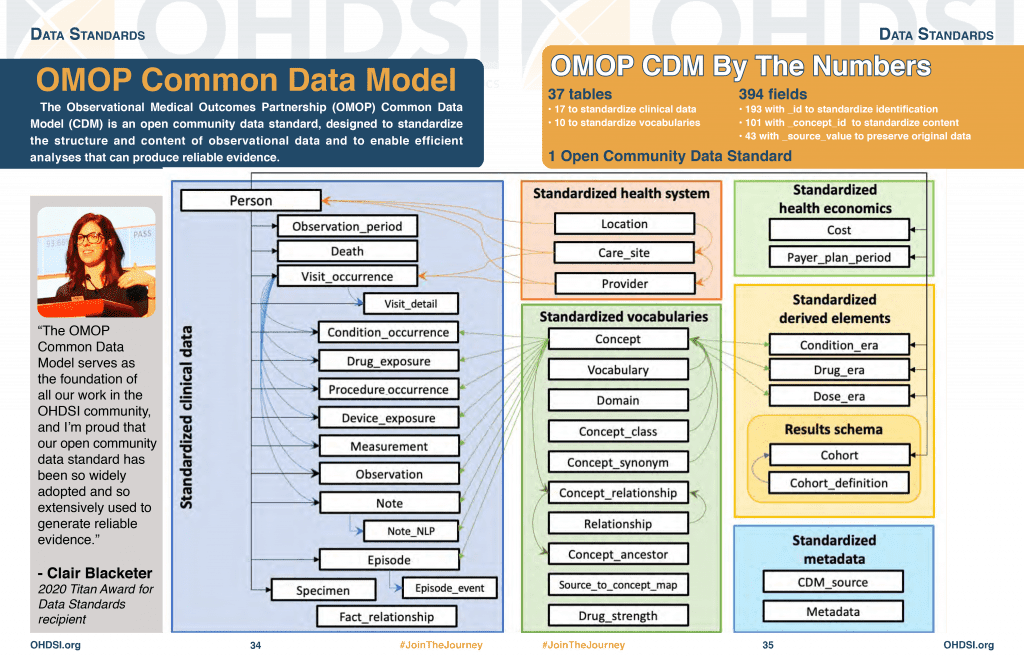
OMOP Common Data Model

The OMOP Common Data Model allows for the systematic analysis of disparate observational databases. The concept behind this approach is to transform data contained within those databases into a common format (data model) as well as a common representation (terminologies, vocabularies, coding schemes), and then perform systematic analyses using a library of standard analytic routines that have been written based on the common format.

Continue Reading