




Electrochemical Sensor for Detailed SARS-CoV-2 Immunity Data

Electrochemical Sensor for Detailed SARS-CoV-2 Immunity Data

Researchers at the Harvard Wyss Institute have developed an electrochemical device, called the eRapid sensor, that can assist clinicians in quickly characterizing someone’s COVID-19 infection, including identifying the infecting viral variant and the nature of someone’s immunity to the virus in terms of whether it is vaccine-mediated or natural immunity. Monitoring these characteristics could help to personalize treatment for individuals and also provide data for drug development and inform government decisions on the best way to manage COVID-19 in the community. When antibodies from a blood sample bind within the device, it precipitates a biochemical cascade that affects the electrical […]…

Continue Reading


Nanowire Assay Detects Brain Tumors from Urine

Nanowire Assay Detects Brain Tumors from Urine

Researchers at Nagoya University in Japan have developed a nanowire assay that can be used to capture and detect specific extracellular vesicles in a urine sample that indicate the presence of a brain tumor. These extracellular vesicles are naturally excreted in the urine but techniques to capture and analyze them have been complex, requiring different pieces of equipment, until now. This all-in-one assay uses a simple well plate that has been coated with zinc oxide nanowires that extracellular vesicles are attracted to because of their surface electrical charge. Then, the researchers can detect tumor-specific extracellular vesicles in each well using […]…

Continue Reading
Epic, eHealth Exchange and CommonWell among HHS-approved QHIN candidates

Epic, eHealth Exchange and CommonWell among HHS-approved QHIN candidates

A half-dozen organizations on Monday were approved by the Department of Health and Human Services as the inaugural batch of candidates to participate as qualified health information networks as part of ONC’s Trusted Exchange Framework and Common Agreement.During a Feb. 13 event at the U.S. Department of Health and Human Services, six healthcare organizations were approved to implement TEFCA as prospective QHINs: CommonWell Health Alliance, eHealth Exchange, Epic TEFCA Interoperability Services, Health Gorilla, Kno2, and KONZA National Network.
In a blog post, National Coordinator for Health IT Micky Tripathi recognized those organizations, “for their willingness to voluntarily step up and meet the…

Continue Reading
95% of Certified Health IT Developers Met ONC Cures Act Deadline

95% of Certified Health IT Developers Met ONC Cures Act Deadline

– More than 95 percent of certified health IT developers met the Cures Act Final Rule compliance deadline to provide customers with new technology, according to an ONC HealthITBuzz blog post. The Cures Act Final Rule mandated many changes to the Certification Program, including four updates set to have long-lasting interoperability impacts on patients, clinicians, and developers. ONC Certified Health IT developers must: Advance interoperability for patients and providers through the use of FHIR-based application programming interfaces (APIs);Enable patients, providers, and other stakeholders to have access to consistent data elements represented in at least version one of the United States Core…

Continue Reading
How Mental Healthcare Access can Improve to Meet Patient Needs

How Mental Healthcare Access can Improve to Meet Patient Needs

– Meeting patient needs for mental healthcare access will require industry leaders, clinicians, and healthcare policymakers to focus on giving clinicians the tools needed to meet patients in any care setting, as well as enable more ample access to mental healthcare providers, according to a new paper from the Alliance for Patient Access (AfPA). More patients than ever are seeking mental healthcare, with AfPA citing figures that 53 million Americans now live with some kind of mental illness. Exacerbated by the COVID-19 pandemic, this prevalence of mental illness has pushed the mental health space to face unheard-of patient demand. But patients…

Continue Reading
Adverse Survival Signal Leads G1 to Stop Pivotal Test in Colorectal Cancer

Adverse Survival Signal Leads G1 to Stop Pivotal Test in Colorectal Cancer

G1 Therapeutics’ approach to cancer does not kill tumors. Instead, the biotech’s drug, trilaciclib, protects bone marrow from the damaging effects of chemotherapy, reducing the duration and severity of the problems that can limit the use of this cancer treatment. Since trilaciclib’s initial approval insmall cell lung cancer, G1 has pursued more clinical trials that could support expanding the drug to other cancers. Colorectal cancer will no longer be one of them.
On Monday, G1 reported preliminary data showing that the placebo group outperformed the trilaciclib arm in helping patients live longer. G1 said it has decided to stop the colorectal cancer…

Continue Reading
High-Performance Computing Breaks the Genomics Bottleneck

High-Performance Computing Breaks the Genomics Bottleneck

Sequencing our 3.2 billion DNA base pairs is becoming increasingly crucial as genomic testing gains widespread acceptance. Advancements in genomics are improving the detection of mutations that can lead to illnesses, with the potential to revolutionize personalized medicine by enabling the development of more effective treatments for genetic disorders. High-performance computing is revolutionizing the field of genomics by accelerating the speed of analysis and processing of large-scale gene sequencing data sets. However, genomics is facing a massive Big Data problem. Scientists are struggling to process a growing volume of data as precision medicine turns to gene sequencing for individual patients….

Continue Reading
3D Bioengineered Skin Grafts Fit Complex Anatomy

3D Bioengineered Skin Grafts Fit Complex Anatomy

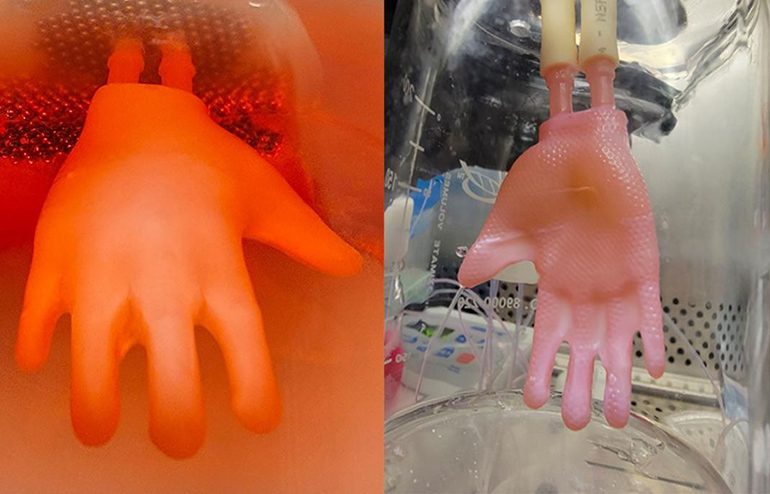
Researchers at Columbia University’s Irving Medical Center have developed a method to create three-dimensional bioengineered skin grafts. To date, bioengineered skin is typically created in flat sheets. However, these are difficult to fit to complex anatomy, such as the hand, and so these researchers have designed a more sophisticated technique that combines laser scanning, 3D printing, and cell culture to create seamless three dimensional skin grafts. For instance, the researchers have already created a skin “glove” that could be useful in replacing skin on the hands by simply slipping it over the hand (just like a glove). Replacing skin that has…

Continue Reading
An inside look at AdventHealth's powerful telemedicine program

An inside look at AdventHealth’s powerful telemedicine program

Most healthcare consumers have experienced certain pain points in receiving care for family and friends.THE PROBLEM
Patient access is a top priority for AdventHealth, a health system based in Altamonte Springs, Florida. For the health system, improving the way it delivers care to patients starts with meeting them at the place of their needs.
“Looking for ways to solve for bringing the right care to the right patient at the right place and time is imperative to stay ahead of the ever-changing landscape,” said Ashley Bard, IT director, care navigation and virtual care technology, at AdventHealth. “In recent years, our users of healthcare…

Continue Reading
Mining EHR data to understand documentation burnout

Mining EHR data to understand documentation burnout

The Office of the National Coordinator for Health Information found that hospitals’ access and analysis of documentation data in electronic health records has increased over the past five years, but gaps in access and use remain for some hospitals.WHY IT MATTERSData from EHRs can track the time clinicians spend documenting and carrying out certain tasks. To measure physician burden on a national scale, ONC analyzed four waves of a nationally representative survey of U.S. non-federal acute care hospitals.
Published in January, in the special health IT issue of the American Journal of Managed Care, Trends in Electronic Health Record Capabilities for Tracking…

Continue Reading