


 The BC College of Physicians and Surgeons 'College Quarterly' highlighted a case in which the pre-population of templated responses with default 'normal' responses potentially contributed to errors in detection of a medical condition in a young child that resulted in a fatal arrhythmia. Another deficiency was an ineffective recall capability in the EMR that was being used. This case highlights the need for safe and usable tools if situations such as this are to be avoided.
The veracity of the medical record is integral to the continuity of medical care. A recent very unfortunate death was brought to the attention of the Quality of Medical Performance Committee to illustrate this. A young child was playing when he began to feel unwell, and shortly thereafter collapsed. Despite resuscitative efforts, he went into full cardiac arrest prior to transport to hospital by the emergency Response Team and was declared dead following resuscitative efforts in the emergency room. At subsequent postmortem, it was determined that this child had developed a fatal arrhythmia as a result of a congenital heart defect known as “idiopathic asymmetric hypertrophic cardiomyopathy.”
The College’s review of this event found that the child had received his medical care from a diligent and competent group of family physicians who used an electronic medical record. In reviewing that record, it was noted that in the three years prior to the death, numerous physicians had seen the child for minor illnesses.
On several occasions, the child had attended a clinic where physicians had heard a heart murmur, which was appropriately recorded. Unfortunately, the clinic’s electronic medical record used a template that would “auto fill” systems as being normal, unless contrary information was entered. Therefore on other visits, when no physician entry was made under Cardiovascular System Review, the “auto fill” would result in the notation, “no history of murmurs or hypertension.” This denied previous clinical findings, and in itself appeared to be an odd entry for a young child since the template was clearly designed for adult use. Moreover, a chest X-ray performed while investigating the possibility of pneumonia stated that the child had cardiomegaly and suggested a specialist consultation. The report was noted by the physician concerned who arranged for a patient recall. Unfortunately, the electronic medical record could not flag the recall. Consequently, the family doctor thought that the recall was for a pneumonia re-examination. Physicians from this clinic also noted that navigating the electronic medical record was difficult, and allowed only for one small screen to be seen at a time. This made scrolling through the medical record awkward and time consuming.
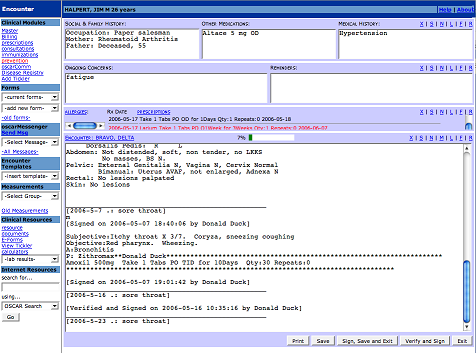
The Quality of Medical Performance Committee felt that there had been numerous red flags in this child’s past medical encounters that would have triggered a cardiology consultation, and might have effected treatment to prevent or postpone this death. Further, they felt it important to advise members that while the electronic medical record has many virtues, it also has the potential for some pitfalls worthy of attention:
- It is important to ensure that the electronic medical record has the ability to flag appropriate follow-up concerns;
- The system must be easy to navigate and allow for multiple screen options;
- The physician must never allow for an automatic template to fill in options stating “normal” when no such exam is performed.
Clinicians are reminded that ensuring the veracity of their clinical records is their own responsibility and essential for good patient care.
Get the full article here http://blog.canadianemr.ca/canadianemr/2007/06/pre-population-.html
| < Prev | Next > |
|---|



 In this section you'll find a list of companies and organizations working in the healthcare IT sector in Egypt.