


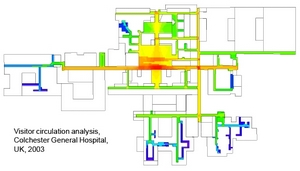
 Space Syntax has developed world-leading methods for analysing spatial layout, observing patterns of space use within the hospital environment and designing ward layouts and hospital circulations which optimise space use and interaction. These techniques work by measuring the properties of spatial layouts that users perceive: lines of sight along streets and corridors, visual fields from public spaces, reception areas and nurse stations and degrees of privacy and openness. Using Space Syntax methodology it is possible to measure the direct consequences of layout design such as movement, levels of co-presence and interaction, and patterns of anti-social behaviour - burglary, vandalism and theft.
The general idea is that spaces can be broken down into components, analyzed as networks of choices, then represented as maps and graphs that describe the relative connectivity and integration of those spaces. It rests on three basic conceptions of space:
- an isovist (popularised by Michael Benedikt at University of Texas), or viewshed or visibility polygon, the field of view from any particular point
- axial space (idea popularized by Bill Hillier at UCL), a straight sight-line and possible path, and
- convex space (popularized by John Peponis and his collaborators at Georgia Tech), an occupiable void where, if imagined as a wireframe diagram, no line between two of its points goes outside its perimeter, in other words, all points within the polygon are visible to all other points within the polygon.
A human perspective
Our objective is to ensure that hospital designs fulfill the expectations of all their users: patients, staff and visitors.
We do this using tailor-made design techniques to create customer-focused solutions. Our computer models can be used at every stage of the design process from briefing to strategic design and evaluation.
Our focus is people. We help to create places that offer comfort, safety, privacy and dignity to their users. We offer a series of evidence-based design techniques that can substantially reduce the risk involved in the hospital design process.
Experience from practice
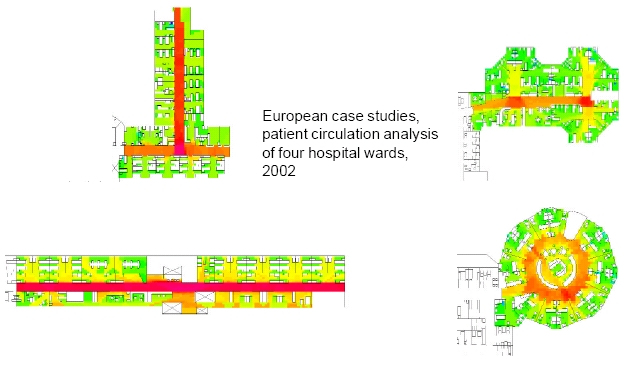
Our recent work with NHS Estates investigates how different ward types - Nightingale, 50/50s and exclusively single-bed wards - affect movement and interaction patterns. Our findings show that the spatial layout of well-designed wards can accommodate requirements of privacy, close nurse-patient access and surveillance and reduced travel distance for nurses, while at the same time provide opportunities for co-presence and informal interaction.
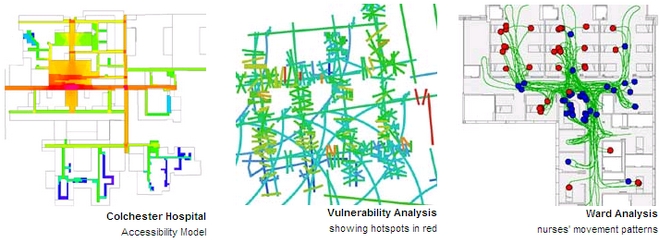
Get more information here http://www.spacesyntax.com/en/projects-and-clients/case-studies/hospital-design.aspx
| < Prev | Next > |
|---|



 In this section you'll find a list of companies and organizations working in the healthcare IT sector in Egypt.