


 Mirth is an open source cross-platform HL7 interface engine that enables bi-directional sending of HL7 messages between systems and applications over multiple transports. By utilizing an enterprise service bus framework and a channel-based architecture, Mirth allows messages to be filtered, transformed, and routed based on user-defined rules. Creating HL7 interfaces for existing systems becomes easy using the web-based interface and channel creation wizard which associates applications with Mirth engine components.
Your client or legacy application needs to communicate with disparate health information systems. Your applications don't support HL7, or speak the necessary protocols needed to exchange information. You're looking for a comprehensive integration solution that can handle all of the necessary work to transform and route HL7 messages, and you'd like it to be open source so that you can import existing interfaces to common data sources. Enter Mirth, the "Swiss army knife" HL7 integration engine. Specifically designed for HL7 message integration, Mirth provides the necessary tools for developing, deploying, and monitoring interfaces.
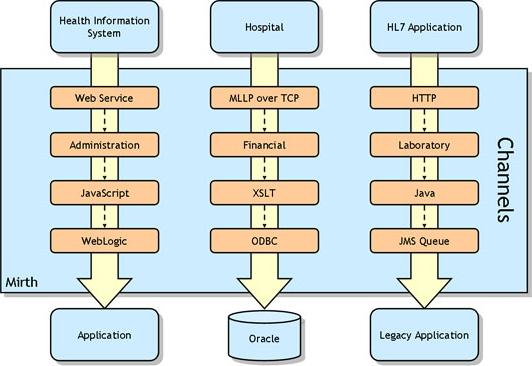
HL7 has established itself as the lingua franca of healthcare information exchange, and in order to integrate your existing services with HL7 systems you must implement an adapter layer to transform messages between your domain and the HL7 world. Mirth makes this step easy by providing the framework for connecting disparate systems with the required protocol adapters and message transformation tools.
Mirth uses a channel-based architecture to connect your systems with other HL7 systems. Channels consist of endpoints (both inbound and outbound), filters, and transformers. Multiple filters and a chain of transformers can be associated with a channel. The Mirth web interface allows for reuse of filters and transformers on multiple channels.
Endpoints are used to configure connections and their protocol details. Inbound endpoints are used to designate the type of listener to use for incoming messages, such as TCP/IP or a web service. Outbound endpoints are used to designate the destination of outgoing messages, such as an application server, a JMS queue, or a database.
For more information, and to download Mirth, please visit http://www.mediformatica.com/administrator/index2.php?option=com_content
| < Prev | Next > |
|---|



 In this section you'll find a list of companies and organizations working in the healthcare IT sector in Egypt.