


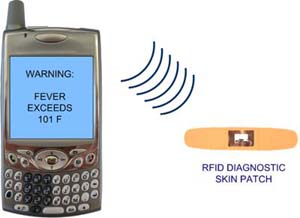
 Some of the UK’s leading experts in location technologies confirmed this week that applications such as RFID in hospitals are already improving the efficiency and quality of patient care. But they also warn that compatibility problems between hardware and software applications, and a lack of joined up thinking from technology companies mean that the NHS is not benefiting as much as it could. A report from Wireless Healthcare UK explores theses fears.
Speakers from the UK government’s Location and Timing Knowledge Transfer Network, the Mobile Data Association and the Royal National Institute of Blind People gathered to discuss the role these technologies play in healthcare and assisted living.
Some successful examples given were:
- RFID tags worn by hospital patients that store their picture and medical records so doctors, nurses and surgeons can retrieve the correct data before administering treatment or medication. Examples include the Safe Surgery System currently in use at Birmingham Heartlands Hospital.
- Asset tracking – For the location of valuable items such as crash trolleys, infusion pumps, beds and wheelchairs. Applications are in the pilot stage in a number of hospitals where active Wi-Fi tags are attached to equipment. Return on investment is based on reducing inventory and time spent locating equipment. Examples of this technology of companies using this technology include Airetrack and Pango.
- Security for babies in maternity units – prevention of abduction. Tamper proof active UHF tags are attached to new born babies linked to UHF antennae and door security systems to prevent unauthorised movement of children. Examples include X-Tag and ELPAS.
- Security of patients with dementia. Active UHF tags worn by patients where location can be determined by RSSI to strategically placed UHF antennae. Staff can be alerted if patients move away from their ‘zone’. Examples include X-tag and Radianse.
- Drug companies are already tagging pharmaceuticals so that they can monitor where drugs are lost and stolen. Astra Zeneca has already tagged more than 50 million syringes to ensure that patients are given the right dose of products.
Bob Cockshott of the Location and Timing Knowledge Transfer Network believes that use of these technologies is already having an impact on our healthcare.
“RFID and other location based technologies are already saving vital working hours, reducing mistakes and cutting waste in the system. To really push forward to the next level we need more joined up thinking between manufacturers and better systems integration to really reap the rewards on a grand scale,” he said.
Nick Hunn, Executive Director of the Mobile Data Association and Chief Technology Officer at Ezurio added “Whilst you may not always realise it immediately as a patient, these type of applications are beginning to have a real impact on the running of the NHS. But we could do so much more. We have to get technology companies, healthcare companies and hospitals to talk to each other and work out the best ways to draw maximum benefit from these emerging technologies. Such innovation may also come from outside the traditional healthcare sector.”
Earlier this year Sonitor introduced the P-Tag, which weighs less than an ounce and measures 1.4×1.5×0.7 inches. It is a small battery-powered wireless device that can be attached by snapping the shell onto a standard patient wristband, or similar band or lanyard.
A feature of the tag is that it is protected against possible infectious contamination by the disposable outer shell, the core is designed for repeated use without the need for cleaning.
“This inexpensive outer shell provides the needed hygienic barrier to eliminate possible risks of infection which is associated with the reuse of other RFID and WiFi tracking tags that are only adapted and not purpose-built for patient use” said Dr. Wilfred Booij, Sonitor Technologies’ CTO.
Get more information here http://www.wirelesshealthcare.co.uk/wh/news/wk20-08-0004.htm
| < Prev | Next > |
|---|



 In this section you'll find a list of companies and organizations working in the healthcare IT sector in Egypt.