


Optimal patient care requires efficient access to comprehensive electronic health records (EHRs). IHE accelerates the adoption of the information standards needed to support EHRs. More than 100 vendors have implemented and tested products based on IHE. IHE improves patient care by harmonizing healthcare information exchange and provides a common standards-based framework for seamlessly passing health information among care providers, enabling local, regional and national health information networks.
IHE enhances the quality of patient care, resulting in the following benefits:
- Safety through the reduction of medical errors
- Savings through lower implementation costs and more efficient workflow
- Satisfaction through better informed medical decisions and faster results for both patient and physician
”IHE supports the nation’s goal of achieving a national healthcare information network because when IHE profiles are incorporated into EHR products, it is easier to access and share patient information.”
— GREG WALTON, EXECUTIVE VICE PRESIDENT AND CIO, CARILION HEALTH SYSTEM
THE FOUR STEPS OF THE IHE PROCESS
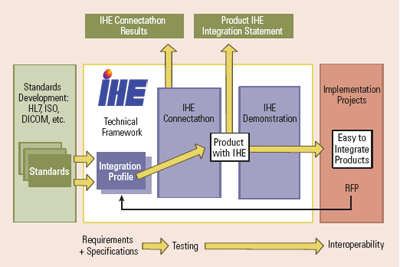
IHE follows a defined, coordinated process for standards adoption. These steps repeat annually, promoting steady improvements in integration.
I. Identify Interoperability Problems. Clinicians and IT experts work to identify common interoperability problems with information access, clinical workflow, administration and the underlying infrastructure.
II. Specify Integration Profiles. Experienced healthcare IT professionals identify relevant standards and define how to apply them to adress the problems, documenting them in the form of IHE integration profiles.
III. Test Systems at the Connectathon. Vendors implement IHE integration profiles in their products and test their systems for interoperability at the annual IHE Connectathon. This allows them to assess the maturity of their implementation and resolve issues of interoperability in a supervised testing environment.
IV. Publish Integration Statements for use in RFPs. Vendors publish IHE integration statements to document the IHE integration profiles their products support. Users can reference the IHE integration profiles in requests for proposals, greatly simplifying the systems acquisition process.
THE TECHNICAL FRAMEWORK — PUTTING BUSINESS AND TECHNOLOGY TOGETHER
The Technical Framework consists of two parts:
Integration Profiles and Transactions. The Integration Profiles model the business process problem and the solution to the problem; the Transactions section defines in thorough detail the way in which current standards are used to solve the business problem defined in the Integration
Profiles. Integration Profiles are based on the following modeling concepts:

An Actor. A system or part of a system that creates, manages or acts upon data.
A Transaction. A specific interaction between Actors to exchange information.
Here are a few examples of Actors and Transactions used in IHE integration profiles.

LEADING BY EXAMPLE
IHE participants promote interoperability by building systems that conform to an industry-wide framework for implementing standards. More than 100 healthcare vendors worldwide offer ready-to-integrate products to benefit healthcare enterprises of all sizes. CIOs and clinicians appreciate the positive impact IHE has made on radiology, cardiology, laboratory and enterprise infrastructure as well as powerful cross-enterprise healthcare infrastructures.
IHE AND THE ELECTRONIC HEALTH RECORD (EHR)
IHE has defined a common framework to deliver the basic interoperability needed for local and regional health information networks. It has developed a foundational set of standards-based integration profiles for information exchange with three interrelated efforts:
- Cross-Enterprise Document Sharing (XDS) support for document content interoperability. This supports a standards-based EHR across clinical encounters and care settings.
- A security framework for protecting the confidentiality, authenticity and integrity of patient care data.
- Cross-domain patient identification management to ensure consistent patient information and effective searches for EHRs.
To get more information about IHE please visit their website.
| < Prev | Next > |
|---|



 In this section you'll find a list of companies and organizations working in the healthcare IT sector in Egypt.